I like my fictional stories internally consistent. That doesn’t always have to mean they’re realistic (I like fantasy but I know dragons aren’t real), but they should be consistent within the rules they set for themselves. If the bad guys keep shooting at but missing the main characters, that’s bad writing. If it turns out later that they were all untrained, that’s great writing, because it’s internally consistent.
A lot of internally inconsistent stuff in film relates to sound. This is often done intentionally because viewers expect the incorrect thing, and it’s called the coconut effect. For example film makers dub in the cry of a red-tailed hawk instead of an eagle because a real eagle sounds weird and not what people expect an eagle to sound like. See the calls of a red-tailed hawk and a bald eagle below.
Other examples include suppressed gunshots making a barely audible sound (suppressors reduce the sound of a gunshot, but not by much), swords making a metallic “shing” when drawn from leather scabbards, punches making loud thwacking sounds, and of course coconut shells being used instead of horse hooves (this is what Monty Python were nodding to in The Holy Grail).
Speaking of firearms, have you ever noticed how people get knocked over by bullets in movies even if they’re wearing body armour and otherwise end up being uninjured? (except they’ll often claim broken rib, which is itself a bit suspect) That doesn’t happen — bullets have fairly little momentum and do most of their damage with penetration due to their small size relative to their speed.
This doesn’t matter much in the grand scheme of things of course, and I get that film makers are catering to average audience expectations rather than people who know more about firearms and bald eagles, but it always instantly makes me enjoy a movie a little less.
I have a paid Claude subscription, which I use a lot (and get much more than the ~$30 subscription fee in terms of value). Sometimes it codes something for me for a task. Most of the time it’s something that I only use once and that I wouldn’t share. Increasingly, I’m making stuff that might be more generally useful for others. I’ve made a page here where I’ll share these tools.
This will allow you to quickly use Claude Sonnet 4 to generate questions/answers about some text you’re trying to understand which you can import directly into the flashcard app Anki (or you could use them in some other way with some creativity). For example, I built this to input the text from reports and articles I try to understand for work so I can quiz myself on the key concepts.
This is probably the first code I’ve built and deployed using AI that I can see myself using on an ongoing basis. I thought I’d share in case it’s of use to others.
Below is the Claude Sonnet 4 prompt behind the application:
You are an expert at creating spaced repetition prompts following Andy Matuschak’s principles. Generate high-quality flashcard prompts from the following text. Guidelines for good prompts: – Each prompt should be ATOMIC: testing one specific idea, fact, or concept – Questions should require RECALL, not recognition – Be PRECISE: there should be only one correct answer – Focus on UNDERSTANDING: prioritize concepts that build mental models, not trivia – Include CONTEXT: questions should make sense even months later – Vary question types: definitions, relationships, causes/effects, comparisons, applications – For technical content: focus on “why” and “how”, not just “what” – For historical/narrative content: focus on causal relationships and significance Generate 8-15 prompts depending on the density of the content. Return ONLY a JSON array with no other text, formatted exactly like this: [ {“q”: “Question text here?”, “a”: “Answer text here”}, {“q”: “Another question?”, “a”: “Another answer”} ] Text to process: [YOUR PASTED TEXT GOES HERE]
Lessons from 1.5 years in energy consumer advocacy
Disclaimer: Views expressed are my own and do not represent Energy Consumers Australia.
This post has not been peer reviewed. I spent 11 hours on it and used AI heavily throughout the research and writing process. Most of the time was spent working on the spreadsheet and Guesstimate cost benefit analysis. You can see a copy of my initial Claude prompts here. If the topic is of interest, I can see myself revisiting this in the future and going deeper.
People with technical backgrounds in regulated industries (energy, telecommunications, water, finance)
People interested in climate change as a cause area but who want to work outside traditional environmental advocacy
People looking for earning-to-give opportunities that also offer meaningful direct impact
Anyone considering how to have policy impact from outside government
Introduction
In mid-2024, I took a role as an Executive Manager of Advocacy and Policy at Energy Consumers Australia (ECA), the independent national advocate for residential and small business energy consumers in Australia. I recently left after 1.5 years.
This role was primarily about earning to give and career development (it’s for-purpose work, but didn’t seem anything like top recommended charity levels of impact) — specifically, leveraging my resources sector background to build expertise in energy policy given its relevance to data centres and therefore AI. But I also had opportunities for direct impact that I didn’t fully anticipate going in.
This post covers what I learned about a theory of change that may be impactful in other EA cause areas: technical policy reform through regulatory systems that are surprisingly accessible to outsiders. I’ll use a rule change request I wrote and lodged as a case study, attempt a rough impact estimate, and share lessons that might be useful for others considering similar work. You should skip over sections you’re not interested in.
What is Energy Consumers Australia?
Energy Consumers Australia is a small non-profit (~25 staff) funded through levies on energy consumers (~$1 AU per household per year). Its mandate is to advocate for the long-term interests of residential and small business energy consumers in Australia’s National Electricity Market.
ECA has a unique position: it has a “seat at the table” with key decision-makers, including the Energy and Climate Change Ministerial Council (state and federal climate change ministers), the Australian Energy Market Commission (AEMC), the Australian Energy Regulator (AER), and the Australian Energy Market Operator (AEMO). This gives its voice more weight than most advocacy organisations.
A quick primer on rule changes
Australia’s electricity system operates under the National Electricity Rules — a detailed regulatory framework that governs everything from how networks plan infrastructure to how wholesale energy markets operate. These rules have the force of law but are easier to change than legislation. Technically, they’re a form of “delegated legislation” — Australian Parliament has delegated rule-making authority to the AEMC, which can make and amend rules within the framework set by the National Electricity Law.
Any organisation or individual can lodge a rule change request, which the AEMC must consider and provide a formal response. With the right idea, analysis, and stakeholder engagement, a single organisation or person could theoretically change the rules.
This is unusual. In most policy domains, changing the rules requires either convincing legislators (hard), mobilising public pressure (slow), or working from inside government (limited access). The National Electricity Rules represent a relatively straightforward path to having impact that doesn’t exist in many other sectors.
Case study: The Integrated Distribution System Planning rule change
The problem (this is inside baseball, skip if you don’t want the detail)
Australia’s distribution planning rules date from an era when electricity flowed one way — from large power stations to passive consumers. The rules focus on annual maximum demand: ensuring there’s enough capacity to meet peak usage (usually, the hottest day of the year when air conditioners are working the hardest, and likely a cloudy day when rooftop solar is at its lowest output).
But the grid has changed dramatically. Over 4 million Australian households now have rooftop solar. Household batteries and electric vehicles are proliferating. The grid is no longer one-way; it’s a complex, bidirectional system where consumers are also producers.
The current Distribution Annual Planning Reports that networks must produce each year have several problems:
Wrong focus: They’re centred on maximum demand, even though the grid is underutilised most of the year and increasingly constrained by minimum demand (when solar generation exceeds consumption).
Poor visibility: Networks lack requirements to transparently share information about low-voltage network capacity, hosting capacity for solar, or where constraints exist.
Misaligned planning horizons: Distribution planning uses a 5-year horizon, while the Integrated System Plan for transmission looks 20+ years ahead. An efficiently planned network should plan further in advance.
This results in inefficient investment decisions in EV chargers, mid-sized batteries and solar, underutilised consumer solar and batteries, and an inefficiently planned network resulting in consumers paying more than they should for network infrastructure.
This matters because distribution networks — the local poles and wires connecting homes and businesses to the grid — account for around 35% of household electricity bills. The total regulatory asset base of Australia’s electricity distribution networks is over $82 billion, which consumers effectively pay for. Getting the rules right for how this infrastructure is planned, built, and operated has enormous implications for consumer costs and for Australia’s ability to integrate the solar panels, batteries, and electric vehicles that are central to decarbonisation.
The intervention
I wrote a rule change request (supported by a team) proposing to replace the existing Distribution Annual Planning Report with an Integrated Distribution System Plan (IDSP). Key features included:
Requirements for networks to publish hosting capacity maps and constraint information
Data sharing standards to improve visibility of the low-voltage network
Community and stakeholder engagement obligations
New utilisation metrics to track whether networks are using existing infrastructure efficiently
The process took about 4 months from initial concept to lodging in January 2025. This involved multiple rounds of collaboration with my colleagues at ECA, as well as extensive consultation with industry stakeholders including AEMO, AEMC, and AER.
Stakeholder engagement for subsequent phases — responding to consultation papers, meeting with stakeholders, and attending public forums — took ~2 additional months throughout 2025.
Reception and current status
The rule change received 30+ stakeholder submissions and substantial engagement. In October 2025, the AEMC published a directions paper with three policy options for consultation, all of which address most of the core problems identified in our proposal. The most important decision-maker, the AEMC, appears largely on board with the direction of reform.
I currently estimate 80% probability that the rule change is implemented in a form similar to the directions paper, given it’s late in the consultation process and we’ve heard from the decision maker. We’ll know for sure by around mid-2026.
Stakeholder engagement: Five principles
A rule change request is half technical analysis, half stakeholder engagement. These are five principles of stakeholder engagement that I think generalise beyond energy policy:
1. Map your stakeholders
Identify who has influence over the decision, who is affected by the outcome, and who can help or hinder your proposal. In our case, this meant networks, retailers, consumer groups, state governments, and the market bodies themselves.
2. Build your evidence base
Ask stakeholders what problems they face with current rules. Their stories strengthen your case. We spoke with community energy groups, installers, and aggregators who had direct experience with the inadequacies of current planning processes.
3. Test early and often
Get feedback on your proposal while drafting. Refine before you submit. We shared early versions with key stakeholders and incorporated their feedback, which both improved the proposal and built buy-in.
4. Understand the opposition
For those who disagree, ask: what would need to change for them to support you? Some networks were concerned about compliance costs. Understanding their constraints helped us design transitional arrangements. Some gave us ideas we hadn’t thought of.
5. Get out the vote
Supporters need to actually support. Many who would benefit from our rule change never made a submission. Formal submissions carry weight in regulatory processes, so actively encouraging supportive stakeholders to participate matters.
Attribution is complex (would this have happened anyway?)
The counterfactual is unclear (I made a lot of judgement calls in this analysis)
Implementation details matter enormously, which advocates lose control of over time
I’ve tried to be transparent about the significant uncertainty while still attempting a rough estimate.
The internal costs of undertaking the work were relatively low (1.5 FTE for 6 months * overhead costs) so I’m hand waving them away.
A back of the envelope calculation for impact
I’ve created a spreadsheet version of this here. I also attempted a Guesstimate version here. Some numbers in Guesstimate are different because I’m more explicitly using a 90% confidence interval. I’m familiar with CBAs, but haven’t done one this complex myself before.
There are two primary sources of benefits and one primary source of costs I’m modelling here. The benefits of improved planning are enabling more benefits of distributed energy resources (DER — and therefore consumer savings) and reducing network costs (and therefore increasing consumer savings). The cost modelled is in the cost of compliance by networks (and therefore consumer costs).
Given the existing estimate for the benefits of DER was done through to 2040, 2026 to 2040 is the time period I’ve used for this analysis.
There would also be unquantified emissions reduction co-benefits from better integration/higher adoption of renewable energy resources (see Appendix A for how I would have done this if I had more information).
Enabling more benefits from DER
Several analyses have estimated the economic benefits of better integration of DER in Australia:
Baringa Partners estimated that efficient DER integration could avoid $11 billion in network investment by 2040
IEEFA’s meta-analysis found potential economic benefits of $19+ billion by 2040 from optimal DER integration
These figures represent cost savings (avoided network investment, reduced wholesale costs) which are ultimately consumer benefits given these costs are passed on. For this calculation, I’ll use the $10-19 billion range and attempt to estimate the fraction attributable to improved planning rules:
Factor
Estimate
Rationale
Total potential benefits
$11B-19B NPV by 2040
Baringa/IEEFA
Fraction attributable to better planning rules
1-5%
Planning enables but doesn’t directly create savings
Probability of implementation
80%
Based on current progress
Value of 2-year acceleration
~13.3% of total
Would likely have happened eventually (2 years / 15 years)
Benefits due to ECA
$12M-101M
$11B-$19B * 1-5% * 80% * 13.3%
Reduced network costs
Energy consumers (residential and business) pay for the cost of the distribution network through their energy bills. $23 billion of electricity was supplied to households by retailers in 2024-2025. ~35% of this was distribution costs. So household consumers paid $8.05 billion in distribution costs in 2024-2025.
Multiplied by probability of implementation and value of 2-year acceleration
Compliance costs
Complying with the requirements of this rule change has a non-zero cost for distribution networks, which is ultimately passed on to energy consumers. I’ll directly subtract these costs from the benefits.
I estimate approximately 1-2 additional full-time equivalent staff per distribution network service provider (DNSP), ($180-360k) plus modest IT and data costs (~$50k per DNSP), totalling roughly $3-5.3 million annually across the 13 DNSPs in the National Electricity Market.
Over 2026-2040, this represents ~$31-$55 million in NPV terms. Scaled by the probability of implementation (80%) and the value of acceleration of 13.33% (because I’ve assumed the costs would have eventually happened as well as the benefits), this gives ~$3.3-5.9 million in expected compliance costs. These costs are what seem most plausible given my experience, but I’m quite uncertain about them.
Combined estimate
Category
Lower
Upper
DER benefits
$12M
$101M
Network cost savings
$9M
$45M
Compliance costs
-$6M
-$3M
Net total
$15M
$143M
For my personal contribution (~25% attribution as primary author and project leader, with the rest to ECA colleagues and external collaborators):
Range: $4-$36 million in expected consumer savings
Note we should also assume that there’s a decent chance that the second-best candidate for the job would have done similarly as well.
Caveats
I want to be clear about what this calculation does and doesn’t show:
The actual impact depends heavily on implementation details still being determined
I may be motivated to overstate both my contribution and the total value of the project
The counterfactual is uncertain — industry had recognised the need for distribution-level planning and data reform for at least 5 years (for example)
I made some assumptions that I haven’t discussed, such as assuming that the benefits of the rule change are evenly distributed over 2026-2040 (they may be front-loaded, for example)
Be aware of survivorship bias — not all rule change requests are successful or even conclude fully in line with what was lodged
The upper end seems (surprisingly and suspiciously) high for ~6 months of focused work
This analysis also likely makes the precision seem higher than it is
I’m not sharing this as a confident impact claim but as an illustration of the potential leverage available through technical policy reform. It’s also an interesting exercise that I’d encourage others to explore for their own work — just don’t overcorrect based on a BOTEC.
Note also that these are benefits experienced by, in global terms, well-off Australians. $1 of benefits to an Australian is on average less valuable than $1 of benefits to someone in a developing nation, or even just more specifically targeted at Australians in hardship.
Discussion
Some of the numbers in this BOTEC are doing a lot of work without a lot of certainty. The fraction of DER benefits attributable to better planning rules (1-5%) seems safe based on my experience and intuition, but I have low confidence on it.
The probability of implementation being 80% implies that the political will already existed. It’s interesting to me that despite the need for the change being identified for at least 5 years, it did not seem like anyone else was going to start the process in the foreseeable future. This is tied to the next assumption — how much did our lodging of the rule change accelerate the process. AEMC can’t lodge their own rule change requests, but another stakeholder could have.
From my discussions with people in the sector longer than me, it does seem like this is just genuinely a reform that many people wanted but no one got around to prioritising. No one else was working on it, so we accelerated the reform by at least a year, and maybe much more. There is also likely some value in locking in a better version of this reform as a consumer advocate body, relative to perhaps if an industry interest group had lodged a similar rule change.
There is a challenge I’ve experienced in consumer advocacy where the costs of reform tend to be relatively known, while the benefits tend to be relatively unknown. Reform often creates benefits that were unexpected. We expect better planning and more availability of network data to have this potential, but it makes it more difficult to sell the story on a purely cost benefit analysis framework.
I stand behind the ‘qualitative cost benefit analysis’ we conducted as part of the rule change request (page 20 onwards of this), and for what it’s worth, the sector seemed broadly convinced. We didn’t attempt a quantitative cost benefit analysis when lodging the rule change request partly because even with more effort it would have been flimsy.
What surprised me: A different theory of change
Coming from animal advocacy, I expected impact to come through familiar channels: public campaigns, mobilising constituents, and convincing legislators. What I found in energy policy was different. Most of my impact came through relatively non-public, non-exciting work:
Rule change requests
Technical submissions to consultations
Advisory and working groups
Direct engagement with regulators
This isn’t because public pressure doesn’t matter in energy (climate change and cost of living have been top election issues here for years), but the specific architecture of Australia’s energy governance creates unusual opportunities for outsiders to have direct influence through technical channels.
The National Electricity Rules represent an opportunity for small, non-industry/non-government actors to create substantial change that doesn’t exist in many other sectors. Any organisation or even individual can lodge a rule change request which the Australian Energy Market Commission must consider. With the right idea, analysis, and stakeholder engagement, any one person could in theory change the rules and influence the Australian energy sector, but the power and influence that your organisation holds clearly matters a lot.
I looked for some statistics on how many rule change requests end up resulting in rule changes to get a sense of the success rate. 548 rule change requests have been initiated. It’s hard to say how many of them were successful without spending more time, because AEMC doesn’t publish statistics on this, and some of the requests get merged into others. Also, not all rule change requests survive the consultation process intact. It could end up being quite different to what was originally proposed. A little over half of rule changes that have been initiated have commenced (incorporated in the live rules). Overall, I’m reminded of a hits-based giving approach.
Why this might generalise
The broader lesson is: understanding the specific architecture of a policy domain matters enormously for theory of change.
Some questions worth asking about any policy area:
Are there formal mechanisms for outside input (like rule change requests)?
Who actually makes decisions, and what evidence do they rely on?
Is the domain more technocratic or more political?
Where are the leverage points that don’t require legislative change?
Regulatory systems vary widely in how accessible they are to outside influence. Some are essentially closed; others, like Australia’s energy rules, have built-in pathways for external proposals.
Is consumer advocacy neglected from an EA perspective?
Consumer advocacy generally is almost certainly not neglected from an EA perspective, in my view. Consumer protection, fair pricing, and market efficiency are important but not obviously underfunded relative to their importance.
However, consumer advocacy as a vehicle for other cause areas — especially climate change — might be underrated.
The consumer frame can align diverse stakeholders around reforms that also serve climate goals. When I argue that better distribution planning will reduce costs for households, I’m building a coalition that includes people who don’t necessarily prioritise climate but do care about electricity bills. The same reform that saves consumers money also enables faster, cheaper decarbonisation.
However, there are some situations where consumer advocacy may conflict with environmental goals. For example, transitioning away from coal to large and small-scale renewables happens to be cheaper for consumers, but what if it wasn’t? Switching to time-of-use pricing might help with grid decarbonisation, but it might increase bills for some.
Reflections and lessons
On the work itself
Understand institutional architecture before choosing interventions. I could have spent more time trying to influence energy policy through public campaigns. Instead, the rule change pathway offered a more direct route to systemic change.
Technical credibility matters. Rule change requests are evaluated on their merits. Having a PhD (even in an unrelated field) and developing genuine expertise in energy policy may have helped my proposals be taken seriously.
Relationships compound. The stakeholder engagement I did for this rule change built relationships ECA and I will carry into future work. Australian energy policy is a relatively small world; reputation and trust matter.
Patience is required. The rule change process takes 12-18+ months. The benefits, if they materialise at all, will accrue over decades.
On career
This role served multiple goals simultaneously:
Earning to give: Competitive salary in a mainstream policy role
Career capital: Developing expertise in energy policy and regulatory systems
Direct impact: Opportunities like this rule change
The combination feels compelling to me. Many EA career paths frame earning to give and direct impact as separate tracks. But roles in regulated industries can offer both — plus skills relevant to areas like AI governance.
Energy expertise and career capital specifically may become more valuable as AI scaling continues. Data centres are major electricity consumers, and questions about energy infrastructure, grid reliability, and sustainable power sources are increasingly relevant to AI development.
Conclusion
The key lessons I’d highlight:
Technical policy reform from outside government can be a viable theory of change in certain regulatory contexts. Some regulatory systems are surprisingly accessible to outsiders with good ideas and stakeholder engagement skills.
Understanding institutional architecture matters. The specific pathway to change varies enormously across policy domains. Invest in understanding how decisions actually get made.
Stakeholder engagement is half the work. Technical quality is necessary but not sufficient. Building coalitions, understanding opposition, and ensuring supporters actually participate are equally important.
Consumer advocacy can be a vehicle for other goals. Framing reforms around consumer benefit can build coalitions that advance climate and other objectives.
Earning to give and direct impact aren’t mutually exclusive. Roles in regulated industries can offer both.
I’m grateful to my colleagues at ECA for the opportunity to do this work, and to the many external collaborators in the energy sector who engaged constructively with our proposals.
I’m happy to answer questions or discuss further in the comments, and also welcome feedback. I’m particularly interested to hear from people working in the policy space, and whether any of this does/doesn’t resonate. I can also write more deeply about what we specifically did during the project if it’s of interest and use to people.
For context on why I’m leaving ECA — a new opportunity came up that offers continued development as an energy policy expert, strong earning-to-give potential, and the chance to work directly on emissions reduction in Australia.
Appendix A: How to estimate the benefits of reducing emissions
Electricity generated from rooftop solar has a much lower carbon footprint than electricity generated from the grid (as a mix of coal, gas, wind, solar, hydro, and other), though this effect will decrease over time as wholesale generation decarbonises anyway.
The AEMC now formally values emissions reduction in its rule-making using the interim Value of Emissions Reduction (VER), as set out in their March 2025 guidance. The VER starts at $80/tonne CO2-e in 2026 and rises to $420/tonne by 2050 (in 2023 dollars). I could use this to estimate the benefits from this rule change in terms of emissions reduction by enabling more solar generation and battery storage (so solar energy can be used at more carbon intensive times like in the evenings).
I didn’t end up including this in the main analysis because I couldn’t get it to a point that I was comfortable with, but here’s how I would have done it. The main missing link is knowing how much CO2-e we’d expect to be reduced due to distribution-level DER and what percent of that could be attributed to better planning.
Reduced curtailment: Rooftop solar output is being increasingly constrained due to minimum system load and voltage issues. Better visibility of the ability of the network to host DER enables more efficient siting and reduces wasted generation.
Faster deployment: Hosting capacity maps and clearer connection processes accelerate DER installation.
Optimised locations: Transparent constraint information enables community batteries and EV charging infrastructure to be placed where they deliver most value.
I estimate these improvements could increase DER effectiveness by 2-4% (actual analysis would be better, obviously), so I’d multiply the value by 0.02 – 0.04. I’d then multiply this by $80/tonne CO2-e (or maybe integrate it over time to reflect the decreasing emissions reduction value of rooftop solar over time), then multiply it by 80% (for probability of implementation from now) then by 13.33% (for the value of 2-year acceleration).
Note that in some cases the emissions reduction benefits could effectively be passed on to consumers negating the benefits for this analysis, but not necessarily, and not necessarily all of the benefits.
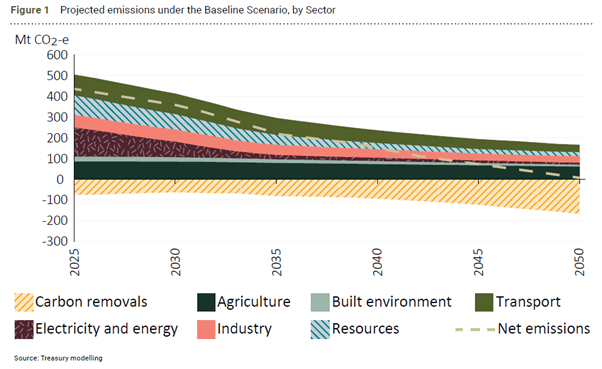
The plan projects a 28% reduction in agricultural emissions by 2050 from today. Because other sectors are decarbonising faster, agriculture will likely make up a growing share of Australia’s remaining gross emissions (37% by 2050), highlighting the challenge and importance of reducing methane and nitrous oxide in the sector.
The plan acknowledges that methane, which dominates agricultural warming, offers our best near-term opportunity to slow warming, due to its shorter atmospheric lifespan but stronger climate forcing effect. Yet the solutions proposed are mostly changes to the existing system: feed additives and a vague mention of “genetics” and “methane vaccines”.
The plan focuses almost entirely on making existing systems slightly better rather than exploring genuinely transformative approaches. There’s no consideration of cellular agriculture, which could dramatically reduce the emissions footprint of protein production. Australian company Vow just became the first to get approval to sell cellular agriculture products here. Our location makes us perfectly positioned to supply Asian markets with these emerging technologies, yet this barely gets a mention.
The efficiency gap between different protein sources is well-documented. Plant-based proteins typically require far less land, water, and energy than animal products. Supporting diversification into high-value plant proteins or new food technologies could open new opportunities and cut emissions. The plan gives limited attention to these possibilities.
What’s particularly frustrating is that agriculture is being treated as uniquely exempt from the scale of change we’re demanding everywhere else. We’re electrifying transport, revolutionising energy generation, and reimagining our built environment. The strategy for this sector relies heavily on incremental improvements, and without a broader vision it risks falling short of the kind of transformation we’ve seen in energy and transport.
I understand the challenges. Food production is essential, farmers’ livelihoods matter, dietary change is personal and complex, and livestock is a harder sector to decarbonise than electricity. But none of this should excuse us from having an honest conversation about what meaningful emissions reduction in agriculture actually requires.
Reforestation plays an important role in the plan and can create major carbon benefits. However, relying heavily on offsets risks postponing deeper changes within agricultural systems themselves. While historic, it’s worth noting that much land clearance in Australia has been for agriculture. For example, 93% of vegetation clearing in Queensland from 2018-19 was for pasture.
The sector plan reads like we’re hoping to innovate our way around fundamental inefficiencies without questioning the system itself. Other countries are investing heavily in alternative proteins and cellular agriculture. Singapore is becoming a hub for food innovation. The Netherlands announced €60 million of funding for cultivated meat and precision fermentation under the National Growth Fund. Where’s Australia’s vision for agricultural transformation?
This doesn’t mean abandoning traditional farming. It means giving producers more options and supporting them through change. It means investing in the infrastructure and research that make Australia a leader in sustainable protein production. It means taking farmers seriously as businesspeople who can adapt and thrive with the right support.
Seven years ago, I wrote about these same issues for my Per Capita Young Writers’ Prize essay. It’s disheartening to see how little the conversation has progressed. We’re still treating agricultural emissions as somehow too hard, too sensitive, or too different to tackle with the same urgency we’re bringing to other sectors.
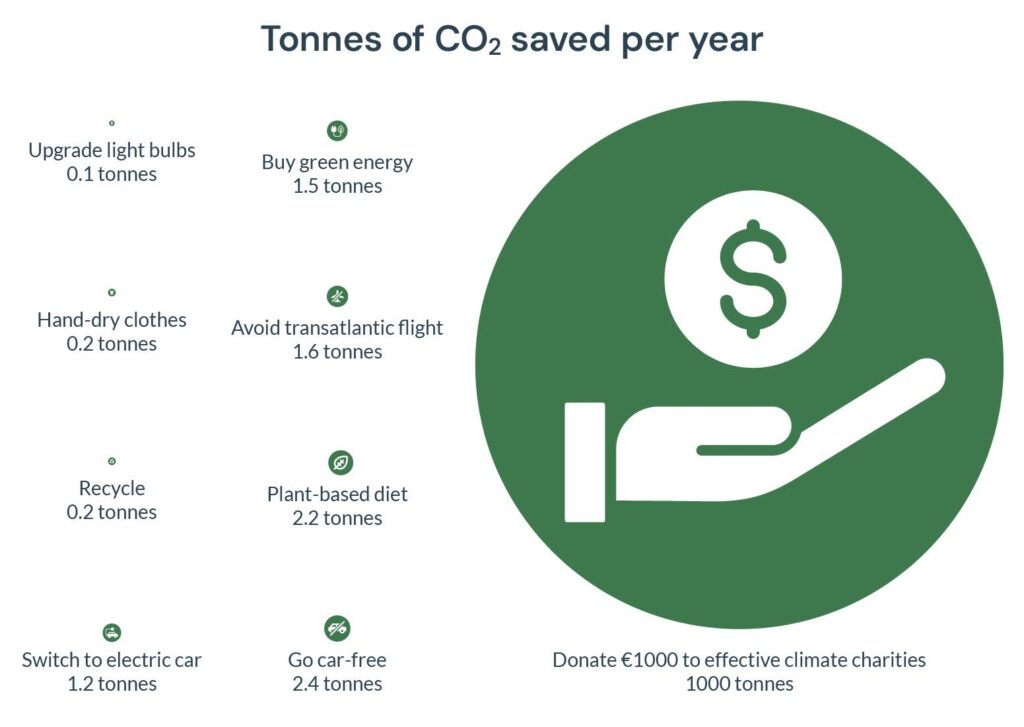
The average Australian produces emissions equivalent to 15 tons of CO2 each year. Naturally, we want to reduce this as much as is practicable — using less electricity, getting rooftop solar, changing our diet, etc. Much of my own work has a focus on decarbonising the energy system.
For the rest of our impact, it’s also natural to explore carbon offsets to try and bring our net impact on the climate to zero. The average cost of an eligible carbon offset in Australia is $25 per ton of CO2. That’s $375 to offset your emissions for a year. Relative to the effort of changing ones’ purchases and behaviour, that’s quite cheap.
But as with the cost to impact ratio of all charities, offsetting emissions follows a Pareto-like distribution (~20% of charities are responsible for ~80% of impact).
A $179AU donation to the Clean Air Task Force is expected to prevent 100 tons of carbon emissions – significantly more effective than most gold-standard offsets, and the same donation to The Good Food Institute is expected to prevent 33 tons, around the same as 20 long haul flights.
Effectively, for a $27 donation each year, one can offset all their emissions.
It’s quite significant that the charity which seems to be the second most effective for offsetting emissions happens to be one of the most impactful places to donate to reduce farmed animal suffering. It’s for this reason that they’re the charity I have donated the most to in dollar terms since 2015. Feed two birds with one scone, as they say.
I hope the takeaway from this is not that there’s no point taking individual actions to reduce one’s emissions, but rather that you can increase your impact further by taking a scientific approach to offsetting your climate impact. And why stop at offsetting only your own impact?
What if Earth’s first microbes weren’t homegrown, but carefully planted by an ancient alien civilization? In this exploration of directed panspermia, we dive into one of science’s most fascinating questions: could intelligent beings seed lifeless planets with the building blocks of life?
Join us as we investigate the possibility that Earth itself might be a cosmic garden, and explore humanity’s potential role as future universe gardeners. Can we seed other planets with life, and should we?
To help me answer these questions, I reached out to Asher Soryl, who recently coauthored a paper with Anders Sandberg on directed panspermia. The paper is forthcoming in Acta Astronautica, and you can contact Asher to get an advance copy.
Many people believe artificial general intelligence will be developed in the next 3 to 4 years. If this is true, the decisions made by the Trump administration could be critical in shaping how transformative AI is deployed, how safe it is, and key arms race-style dynamics. Trumps position and actions on AI really matter. In this video, I covered updates from the last few weeks on DeepSeek and Trump’s position on AI.
While relevant Metaculus predictions haven’t shifted dramatically (median AGI timeline moved slightly closer to 2026), I’d argue that the nature of how we might reach AGI has become riskier. The removal of safety testing requirements and the emphasis on beating China could pressure even traditionally cautious AI labs to move faster than we’d like.
Explore the mind-blowing ethical challenges of transforming Mars into a habitable planet! 🔴➡️🌍
Is terraforming humanity’s next great adventure or a massive moral minefield? In this video, we dive deep into:
⭐ The potential benefits of creating a “backup planet” for humanity
⭐ Massive resource trade-offs and opportunity costs
⭐ Unexpected ethical considerations about introducing life to Mars
Whether you’re a space enthusiast, ethical thinker, or just curious about humanity’s future, this video unpacks the complex questions surrounding Mars terraforming.
Can we really terraform Mars and turn the it into a home for humans? Elon Musk says yes.
What does Elon want to do and what are the challenges? In this video, we explore the science behind transforming Mars into a habitable planet – from using orbital mirrors and nanorods to creating oceans and atmospheres. In this video, I break down the real possibilities and challenges of making Mars our second home.
In this video, I talk about my story of how I came to find my life purpose by dedicating myself to improving the world as much as possible.
I now live on $45,000 AU (after tax and adjusted for inflation from 2016) a year and donate the rest to charities that make a real impact. In this video, I’ll explain why I chose this path, how it’s brought me true happiness, and how I still live comfortably.
Consider taking the Giving What We Can pledge—no matter the amount, it can make a big impact! Try the Giving What We Can trial pledge.